Mostrando postagens com marcador Marin Mersenne. Mostrar todas as postagens

terça-feira, 12 de março de 2013

Marin Mersenne: Harmonie Universelle (1636) - The transverse flute and the recorder

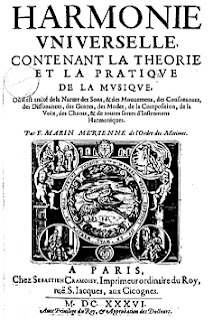
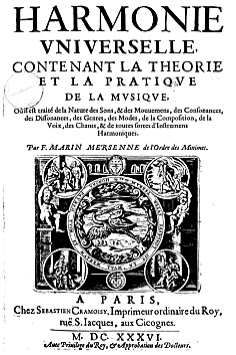
Marin Marsenne (1555-1648) was a French born theologist, priest, philosopher, mathematician and musical theorist. He played an important role in the dissemination of the scientific and philosophical production of his time: he maintained correspondence with Descartes, Galileo, Pascal, and Torricelli (among others). His main contribution to music was a treatise titled "Harmonie Universelle" (1636), which deals with many theoretical and practical aspects of seventeenth-century music - just like a great musical encyclopedia. In this post, I will relate to the definitions of "transverse flute" and "recorder" given by the author.

Transverse flute ("Fluste d'Allemand")

The entry which deals with the transverse flute is titled "Fluste d'Allemand" (if you recall it, the transverse flute was known at that time and in the majority of European countries as "german flute" - if not, go to the post related to the flute in the Middle Ages). Mersenne gives its measures and writes about its basic technical principles: how to hold the flute and how to blow inside of it. He also provides a fingering chart for it.

But even before talking about the transverse flute, Mersenne's concern is to make it clear that the fluste d'Allemand is a completely different instrument from the "Flageollet" (written in some publications with a single "L" instead of a double one). The French version of the flageollet is very similar to the recorder: 

This is an English flageolet. Its sound is very similar to that of an Irish tin whistle. 

On the video posted above, we can hear and see a "double flageolet". Its shape resembles more closely that of an English flageolet. Its sound is somewhere between that of a recorder and an Irish tin whistle.

The precedent image can be found in Mersenne's treatise. The letters and numbers contained in it are there to help the reader to understand what Mersenne wrote: "Even if some people prefer to put this kind of flute in the same category of the Flageollet because they both have six holes to be stopped with the fingers, I chose not to do the same because the embouchure hole is not located in the A B region (as it can be observed in the flutes of the other kind), but in the I hole (...). The embouchure is achieved by placing the inferior lip by the border of that hole and pushing the air rather softly into it.". The author sustains that the embouchure needed to play the transverse flute is more difficult to learn than the embouchure needed to play the flageolet and other similar flutes.

Mersenne also talks about which materials could be used to make transverse flutes. Wood was more commonly employed, especially that of the plum and cherry trees. Ebony was also appreciated. Besides wood, glass and crystal could be used, even though more rarely. Still on the subject of the physical characteristics of the flute, Mersenne provides us with measurements for the holes' diameters, for the distance between them, and for the tube's diameter. But Ardal Powell (The Flute, 2002), sustains that some of those measurements are not accurate. The flute described by Mersenne is, supposedly, a flute in G, but the provided fingering chart seems to relate to a flute in D - and the given distance between each of the finger-holes doesn't seem to correspond with neither instrument. The same fingering chart could be used, according to its author, by those who play the fife ("Fifre"). Mersenne writes that the fifre and the transverse flute are two very similar instruments, differing only in sonority (the tone of the fifre being more piercing and lively) but not in technique.


Recorder ("Fluste d'Angleterre")

The entry which deals with the recorder is called “Fluste d’Angleterre” (“english flute"), also known as “Fluste douce” (“sweet flute”) and nine-hole flute. Its first name is due to the fact that it was first introduced in French territory by an unknown English king. Its second name was inspired by its sweet tone. The origin of its third name is rather obvious: that flute had, indeed, nine finger-holes. Today, this kind of flute is known as “flûte à bec” (“flute with a beak”) by the French.


The flute described by Mersenne could be played by right and left-handed musicians: the last finger-hole (the one located at the end of the flute’s foot joint) was doubled, making it possible for both kinds of flutists to reach it. Mersenne affirms that the recorder and the “Flageollet” had the same extension (a 15th, approximately).


This image can be found in Mersenne’s “Harmonie”. Its shows many musical instruments, most of them recorders. The letters written on the image are meant to help the reader to have a better understanding of which instrument was Mersenne talking about. The instrument pointed by a green arrow is a recorder in its more familiar shape. The blue arrows show a less known kind of recorder. According to the author, that instrument could be 7 or 8 feet long. The blue oval shows a kind of resonating chamber which hides some of the toneholes from our view. Those toneholes are stopped by the action of a key for the small finger. That key is doubled, a feature that allows right and left-handed flutists to play the instrument. Watch the following video to see and to hear this overgrown flute.

This entry mentions a very curious technique. Mersenne points out rather naturally that the natural extension of the recorder can be expanded if the flutists sings and plays at the same time, “for the wind which leaves the mouth while one sings is capable of sounding the flute, making it possible for a single man to play a Duo”. It is interesting to notice that such technique was not mentioned in the entry which deals with the transverse flute. The author mentions solely the possibility to build transverse flutes with two tubes, an invention that would allow a flutist to play a duet without the help of another musician. Maybe Mersenne hadn't met a flutist capable of applying the sing-while-playing technique to the transverse flute with equal success as it was applied to the recorder. It can be inferred that Mersenne thought that such technique could disturb the kind of embouchure needed to play the transverse flute and, therefore, it couldn't be used. Nevertheless, it is worthy of notice that in 1636 a technique that still sounds rather strange to some 21th century listeners was not a stranger to Mersenne and his contemporaries.

Principais fontes:
MERSENNE, Marin. Harmonie Universelle. Paris: 1636. Fac-símile presente em: SAINT-ARROMAN, Jean. Méthodes & Traités: Flûte à Bec - Europe 1500-1800. Vol.I. p.165-168. 3ªEd. Bressuire: Anne Fuzeau Productions, 2001.
MERSENNE, Marin. Harmonie Universelle. Paris: 1636. Fac-símile presente em: SAINT-ARROMAN, Jean. Méthodes & Traités: Flûte Traversière - France 1600-1800. Vol.I. p.7-10. 3ªEd. Bressuire: Anne Fuzeau Productions, 2001.
POWELL, Ardal. The Flute. New Heaven and London: Yale University Press, 2002.

domingo, 12 de agosto de 2012

Marin Mersenne: Harmonie Universelle (1636) - A flauta transversal e a flauta doce

Marin Mersenne (1555-1648) foi um teólogo, padre, filósofo, matemático e teórico musical nascido na França. Foi uma figura importante para a divulgação da produção científica e filosófica de sua época, uma vez que ele mantinha correspondência com vários pensadores importantes daquele tempo, dentre eles Descartes, Galileu, Pascal e Torricelli. No campo da música, sua maior contribuição foi o tratado intitulado "Harmonie Universelle". Publicado no ano de 1636, o "Harmonie" trata sobre vários aspectos práticos e teóricos da música do século XVII, funcionando como uma grande enciclopédia voltada para o assunto. Nesta postagem, tratarei dos verbetes relacionados à flauta transversal e à flauta doce contidos na obra em questão.


Flauta transversal ("Fluste d'Allemand")

O verbete que fala sobre a flauta transversal declara ter como propósito fornecer informações sobre a "Fluste d'Allemand" (se o leitor se recorda bem, a flauta transversal daquela época era conhecida na maioria dos países europeus como "flauta alemã" - ver postagem sobre a flauta na Idade Média). Mersenne escreve sobre as medidas da flauta, além de falar sobre seus princípios básicos de funcionamento: como segurá-la e como conduzir o ar para dentro dela, trazendo também uma tablatura de dedilhados para a produção das notas.

Antes mesmo de começar a falar sobre a flauta transversa, o autor se preocupa em deixar claro que esse tipo de flauta é diferente de um instrumento conhecido como "Flageollet" (em algumas publicações grafado com apenas um "L" no lugar dos dois "L's"), cuja versão francesa, por sua vez, é bastante semelhante à flauta doce:
Esse é um flageolet inglês. Seu som é bem próximo àquele de um tin whistle irlandês.

No vídeo acima, uma demonstração de um "flageolet duplo", o qual se assemelha mais ao modelo inglês de flageolet. Note que o som parece estar entre o som da flauta doce e do tin whistle irlandês (ver postagem sobre os diversos tipos de flauta).


A imagem acima pertence à publicação de Mersenne. As letras e números nela contidos servem para orientar o leitor: "Mesmo que algumas pessoas costumem colocar esse tipo de flauta na categoria do Flageollet por conta deste ter, assim como ela, seis orifícios a serem tapados, preferi colocá-la à parte pelo fato de que a embocadura não se encontra na região A B como acontece nas demais, mas sim no orifício I (...). A embocadura é feita colocando o lábio inferior na borda do primeiro orifício e empurrando o ar bem suavemente para dentro dele.". O autor defende que a embocadura da flauta transversal é bem mais difícil de ser aprendida do que a embocadura das flautas semelhantes ao flageolet. 

Mersenne fala um pouco sobre quais materiais poderiam ser utilizados para fabricar flautas transversais. O material mais usual era a madeira, variando, preferencialmente, entre a do pé de ameixa e da cerejeira. O ébano também poderia ser utilizado. Além da madeira, poderiam ser usados o cristal e o vidro, mas exemplos de flautas nesses materiais são bem mais raros. Ainda falando sobre aspectos físicos da flauta, ele fornece uma série de medidas para os diâmetros dos orifícios, para as distâncias entre eles e para o diâmetro de seu tubo. Ardal Powell, em seu "The Flute", porém, argumenta que há algumas falhas nas medidas dadas: Mersenne fala de uma flauta supostamente afinada em sol, mas a extensão dada pela tablatura de dedilhados parece remeter a uma flauta em ré, enquanto que a distância dada para o espaço entre os orifícios da flauta não corresponde a nenhum dos dois instrumentos. A propósito, a tablatura de dedilhados presente no verbete serve também àquele que toca pífano ("Fifre"). Segundo o autor, ele e a flauta transversal são dois instrumentos extremamente semelhantes, diferindo apenas em sonoridade (a sonoridade do pífano sendo mais estridente e viva) e não em técnica.

Flauta doce ("Fluste d'Angleterre")

O verbete que fala sobre a flauta doce tem como proposta informar o leitor sobre a "Fluste d'Angleterre" (flauta da Inglaterra), também conhecida como "Fluste douce" (flauta doce) e flauta de nove orifícios. Ficou conhecida pelo primeiro nome por ter sido enviada à França por um rei inglês cujo nome não é citado no verbete; pelo segundo nome por conta da doçura de seu som; pelo terceiro nome pelo fato de possuir nove orifícios. Atualmente, é também conhecida entre os franceses como "flûte à bec" (flauta de bico).

A flauta descrita por Mersenne poderia ser tocada tando por destros tanto por canhotos, uma vez que o orifício mais próximo do pé da flauta era dobrado (um furado mais à direita, outro furado mais a esquerda, mas ambos na mesma altura e com o mesmo diâmetro), a fim de que os dedos mínimos das mãos de ambos os tipos de flautistas pudessem alcançá-los. Além disso, ele afirma que a extensão da flauta doce é a mesma extensão do "Flageollet". Conforme a tablatura mostrada por ele, a extensão aproximada seria equivalente a uma décima quinta.
A imagem acima está presente no verbete. Ela mostra vários instrumentos musicais, a maioria deles flautas doces. As letras presentes na imagem servem para que o leitor se localize ao procurar nela as partes dos instrumentos às quais Mersenne faz menção. O instrumento apontado pela seta verde é a flauta doce em sua forma mais conhecida. As setas azuis mostram uma flauta doce menos conhecida. Segundo o autor, tal flauta poderia medir de 7 a 8 pés de comprimento (algo entre dois metros e dois metros e meio!). A elipse azul mostra a peça central da flauta e o orifício escondido por ela, o qual é tapado através da ação de chaves. Em flautas menores, tal orifício é dobrado (conforme descrito um pouco mais acima nesta postagem). Aqui, porém, as chaves que tapam esse orifício são colocadas em ambos os lados da flauta. No vídeo abaixo você poderá ver melhor como funciona e como soa esse instrumento. Para ver outros tipos de flauta doce, visite a postagem referente aos diversos tipos de flauta, presente neste mesmo blog.

Esse verbete traz algumas linhas muito curiosas sobre uma técnica cujo emprego só se faz, atualmente, em música contemporânea e popular. Mersenne comenta com muita naturalidade que a extensão da flauta doce pode ser expandida se o flautista tocar e cantar ao mesmo tempo, "pois o vento que sai da boca enquanto se canta é capaz de fazer a flauta soar, de forma que um homem sozinho pode fazer um Duo". É interessante o fato de que, no verbete voltado para a flauta transversal, tal técnica não foi mencionada. O autor fala apenas sobre a possibilidade da construção de instrumentos dotados de dois tubos, invenções que capacitariam o instrumentista a fazer um duo sem precisar de outro músico para acompanhá-lo. Talvez o autor não tivesse visto em sua relativamente longa vida alguém que fosse capaz de aplicar tal técnica à flauta transversal com a mesma eficiência aplicada à flauta doce, levando-o a crer que o canto interferiria de forma drástica na embocadura necessária para tocar o tipo mencionado de flauta. Não obstante, é realmente notável que, em 1636, alguém já havia escrito sobre algo cuja entrada no repertório técnico flautístico se deu numa época relativamente recente!

Principais fontes:
MERSENNE, Marin. Harmonie Universelle. Paris: 1636. Fac-símile presente em: SAINT-ARROMAN, Jean. Méthodes & Traités: Flûte à Bec - Europe 1500-1800. Vol.I. p.165-168. 3ªEd. Bressuire: Anne Fuzeau Productions, 2001.
MERSENNE, Marin. Harmonie Universelle. Paris: 1636. Fac-símile presente em: SAINT-ARROMAN, Jean. Méthodes & Traités: Flûte Traversière - France 1600-1800. Vol.I. p.7-10. 3ªEd. Bressuire: Anne Fuzeau Productions, 2001.
POWELL, Ardal. The Flute. New Heaven and London: Yale University Press, 2002.